

Today, we are experiencing a period of extraordinary technological change. We see significant progress in cloud gaming, amazing graphics, VR and AR gaming, and mobile games. These lead to the creation of key trends that tend to define innovation in the coming years.
By the end of 2020, nearly half of announced next-gen games were being built in Unreal Engine. In addition, Unreal Engine has given free rein to game developers to use their creativity, so at The Game Awards 2020, video games developed with Unreal Engine were nominated for 17 awards, of which they won 5. Also, they made up over half of the world premieres featured during the main show.
Unreal Engine is not only used in the video game industry but is also used by a growing number of architecture, engineering, and construction (AEC) professionals. According to a survey by CGarchitect, 43% of them use Unreal Engine in their projects, which means almost half.
Updated for Unreal Engine 5. Epic released Unreal Engine 5 in April 2022, and most new projects now start in it. The tips in this guide were written for Unreal Engine 4 and still hold in UE5, which keeps the same editor, Content Browser, Material Editor and Blueprint workflows. Where UE5 changes the advice, we say so.
What is Unreal Engine 4?
Unreal Engine 4 is one of the most popular and widely-used game engines developed by Epic Games. It is easy to use and offers advanced real-time 3D creation tools to create immersive gaming experience and breathtaking graphics. Unreal Engine 4 is free to use, but after your gross revenues from your game exceed USD 1,000,000, there is a 5% royalty that video game developers must pay. “This is amazing for developers, but also students and people who are interested in how a cutting-edge game engine is built from the ground up,” says Filip Coulianos, lead level designer at Hazelight Studios.
Video game developers use Unreal Engine 4 to create titles for PC, mobiles, but also for consoles such as PS4 and PS5, Xbox One and Xbox Series X|S, and Nintendo Switch. Precisely, this flexibility to create video games on multiple platforms is one of the reasons why Unreal Engine is so widely used globally.
What games have been made with Unreal Engine 4?
When you say Unreal Engine 4, you think first of photorealism. If you are watching a scene cut from a video game and do not know if it is a real-life image or created from scratch, it is very likely to be designed with Unreal Engine 4. That’s why Epic Games’ technology is preferred primarily by the famous video game studios. But this is not a rule because Unreal Engine 4 is also used successfully by indie game development studios. Perhaps the most famous video game created with Unreal Engine is Fortnite, developed by Epic Games.

More epic games developed with Unreal Engine 4 are:
- Yoshi’s Crafted World
- Hellblade: Senua’s Sacrifice
- Street Fighter 5
- Star Wars Jedi: Fallen Order
- Robo Recall
- Shenmue 3
- Tetris Effect
- Sea Of Thieves
- observer
- Borderlands 3
- Little Nightmares 1 & 2
- Dragon Ball FighterZ
What is the difference between Unreal Engine 4 and Unreal Engine 5?
The launch of Unreal Engine 5 was eagerly awaited. The announcement, made during Geoff Keighley’s Summer Game Fest, featured an impressive tech demo, demonstrating what should be the “foundation for a new generation of games,” – said Epic CEO Tim Sweeney, during an interview with GamesIndustry.biz. Games made with Unreal Engine 4 will be compatible with Unreal Engine 5 and can even be moved to it.
One of the problems that Unreal Engine 5 solves is budget constraints. Usually, the budget allocated to developing a video game indicates how long the game developers will work on the project. Unfortunately, this prevents them from putting out an extremely polished game for players to play within the time they have. To get rid of this hurdle, Epic Games made its Quixel Megascans library free to use in Unreal Engine, giving developers a large library of ready-made, scanned assets instead of building everything from scratch. Since late 2024, Megascans have been part of Fab, Epic’s content marketplace, so check the current pricing and licence before planning around them.
Unreal Engine 5 entered Early Access on May 26, 2021, and the full release, Unreal Engine 5.0, followed in April 2022. Epic has shipped regular 5.x updates since; Unreal Engine 4’s last version is 4.27. Projects made in UE4 can be opened and converted in UE5.
What changes in Unreal Engine 5
Most of what you know from UE4 carries over. These are the changes that affect how you build:
- Nanite: virtualised geometry that renders very high-polygon meshes efficiently, so supported static meshes no longer need hand-made LODs. It does not reduce texture memory, so texture budgets still matter.
- Lumen: dynamic global illumination and reflections, so lighting reacts in real time without rebuilding lightmaps after every change. Baked lighting with Lightmass is still available where you need it.
- World Partition: replaces UE4’s World Composition and manual level streaming for large maps. The world is split into a grid that streams automatically, and One File Per Actor lets several people edit the same map at once.
- Enhanced Input: the default input system since UE 5.1, replacing UE4’s Action and Axis Mappings with Input Actions and Input Mapping Contexts. New projects should use it from the start.
- Chaos physics: replaces PhysX as the physics engine, covering rigid bodies, destruction, cloth and vehicles.
Nanite and Lumen are aimed mainly at PC and current-generation consoles. For mobile projects, plan on traditional LODs and lighting, as in UE4.
What does Unreal Engine 4 allow you to do?
Unreal Engine 4’s flexibility allows game developers to handle a wide variety of 3D projects. It offers everything they need to get started, grow great game ideas and get out of the crowd with the final product.
Thanks to native integration with the most popular platforms, including Oculus VR, SteamVR, HoloLens 2, Magic Leap, Windows Mixed Reality, ARKit, and ARCore, Unreal Engine 4 offers one of the highest-quality solutions for creating augmented reality (AR), virtual reality (VR), and mixed reality (MR) experiences. Epic Games also provides access to the entire C ++ source code for the engine, which can be downloaded for free from GitHub. In Unreal Engine 5, most of these headsets are supported through the OpenXR standard.
Unreal Engine allows for quick prototyping and iteration, which is very useful when starting a new project. This is the main reason why Moss developer Polyarc chose to work with Unreal Engine 4. “One of the things with UE4 that stood out was its ease of prototyping, getting ideas into a digestible form” – Joshua Stiksma, Polyarc.
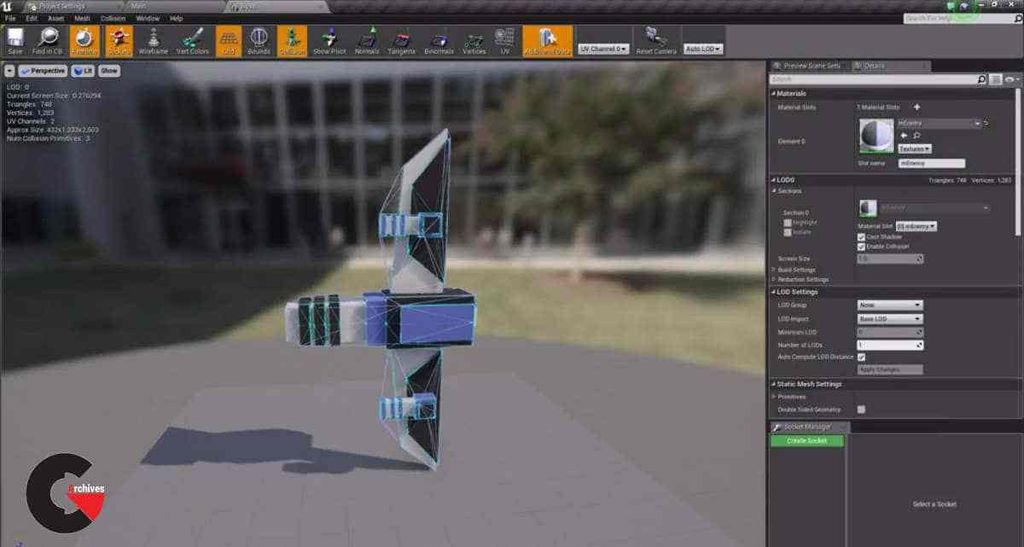
Prototyping in Unreal Engine 4
Unreal Engine 4 allows game designers who don’t have a technical background to explore their ideas without code. Blueprint‘s visual scripting system allows designers to drag-and-drop nodes and add wires to connect them and add logic.
The game engine has a broad toolset and a robust editor that “provides solutions for pretty much every macro task you’ll have to address: scene layout including landscape and foliage, cinematics, visual scripting, particle system, animation network, materials creation, lightmapping, asset management, level of details, physics, basic bricks of AI, performance and memory tracking tools for optimization – Dontnod’s Banal.
Thanks to performance tracking, Unreal Engine 4 is the best choice for VR development games. The game engine monitors performance and allows game developers to optimize costs and the game itself by collecting and tracking game data. In UE5, Unreal Insights is the main tool for profiling CPU, GPU, memory and loading.
What do you have to do to develop a video game with Unreal Engine 4?
To work with Unreal Engine 4, you must be willing to adapt both now and in the future. To benefit from the game engine’s versatility, game developers will probably need to tweak the engine to suit their needs. Although Unreal Engine 4 provides you with many tools, do not assume it will solve all your problems. Therefore, users should take the time to learn all the tools and general construction of the engine to avoid encountering problems during the game development process.
Texture tips in Unreal Engine 4
Many game developers love that Unreal Engine 4 offers much control in creating their own materials. They can import textures in a few clicks via the Import button in the Content Browser, which can be in .tgas and .pngs to .psds and .jpgs formats. One important tip is to make sure normal maps are compressed as TC Normalmap to prevent visual errors in the engine. Also, be aware that if your texture dimensions do not follow the power of two, they won’t stream or have mipmaps. The same rules apply in UE5.
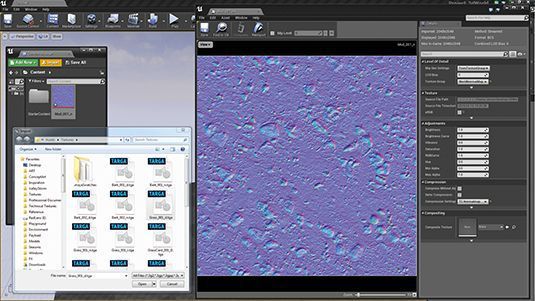
Textures can be imported in a few clicks via the Import button in the Content Browser
Another tip is to avoid unnecessary textures. Reducing textures can save you time and memory. For example, for 100 percent non-metal materials like wood or dirt, a metalness texture can be substituted in the Material Editor for a simple float constant with a value of 0.
Organizational tips and materials in Unreal Engine 4
In the video game world, there are many objects, and the materials have the role of defining the appearance of these objects. For example, the materials can indicate the colors of the objects, if it is bright, transparent, etc. The materials are used for almost all the visual elements in the game. Fortunately, for more complex materials, Unreal Engine 4 comes to provide some effective tools that help in organizing. For example, selecting a group of nodes and pressing C puts those nodes into a comment, which can then be moved as a group and color-coded. To improve readability, game developers can add basic text explanations to comments.
For variations of the same material, such as different colours or roughness values, create Material Instances with exposed parameters instead of duplicating the material. Instances are cheaper to iterate on and keep the number of shaders down, in UE4 and UE5 alike.
Tips for colors and lights in Unreal Engine 4
To correct and modify colors, game developers use the color look-up tables. Using post-process volumes, final render colors can be tweaked and adjusted based on artistic preference. Although there are options for setting basic contrasts and color shades, game developers use color look-up tables to customize colors. These tables allow for complex color transformation, which can be made with a base file available on Epic’s Unreal 4 documentation site and Photoshop.

Colour look-up tables allow for complex colour transformation
In Unreal Engine 5, the post-process volume’s Color Grading settings cover most of these adjustments without leaving the editor, and look-up tables still work if your team already relies on them.
Conclusion
Unreal Engine 4 laid the groundwork for creating amazing graphics and breathtaking video games, and Unreal Engine 5 builds on it. Most of the habits above carry over unchanged, while Nanite, Lumen and World Partition change how you approach geometry, lighting and large worlds.
Planning an Unreal Engine project? Starloop Studios works alongside in-house teams as a co-development partner, adding programmers, artists and designers to your production. Talk to us about Unreal Engine co-development.
Starloop Studios is proud to be part of the Magic Media group, an international group specialising in entertainment and gaming industry services. Our wide range of offerings includes VFX, blockchain gaming, game art services, and more. Reach out today to avail of our expertise and A-Z services for your projects.